


South Korean Researchers Develop Solid-State Thermal Transistor
Scientists have created a device that uses electrical voltage to regulate heat transfer in a crystal without a compressor, refrigerant, or moving parts.
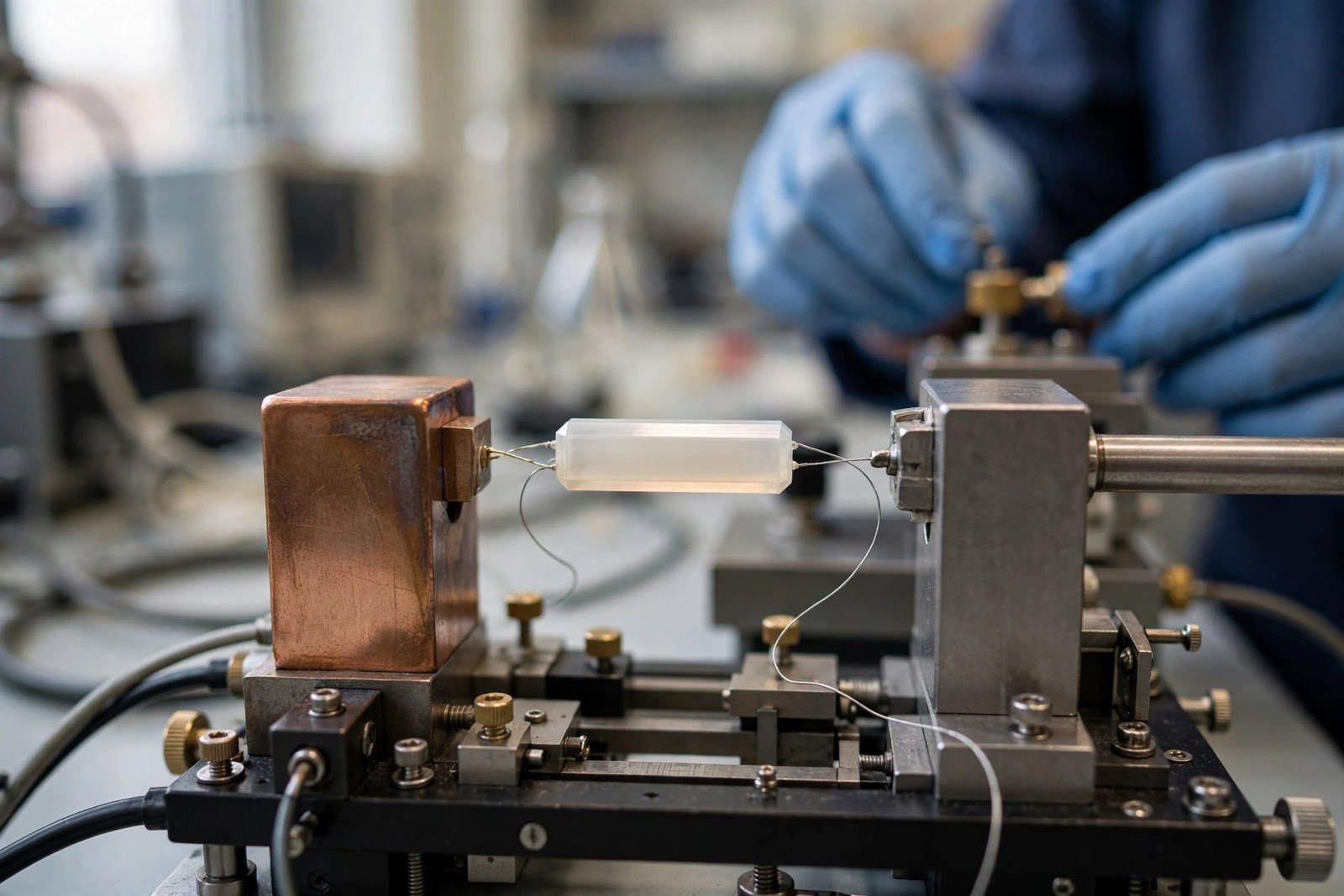
The basis of the transistor is a bulk single crystal of barium titanate. Under the influence of an electric field, its thermal conductivity changes from 2.7 to 4.3 W/(m·K). This occurs due to the reorientation of ferroelectric domains—regions with different polarization directions. Heat transfer is provided by phonons, which propagate with varying efficiency in different domains.
In a laboratory test with a model house and a heated body mock-up, the device either retained heat as needed, increasing the mock-up's temperature by approximately 0.6 °C, or enhanced its dissipation. With two switchings per day, the average power consumption was 33 µW/cm²—about nine times less than that of a heat pump with a compressor for the same task.
The transistor cannot transfer heat against a temperature gradient and therefore does not replace a refrigeration unit. The authors consider it as a supplement to such systems, as well as a means for managing heat exchange in buildings, cooling batteries and power electronics, and thermal regulation of spacecraft.

Read also

Scientists at Virginia Tech convert PVC into base for synthetic oil
Science27 Nov, 15:30
Physicists trapped antimatter in a breakthrough that could explain why the Universe exists
Science27 Nov, 12:28